
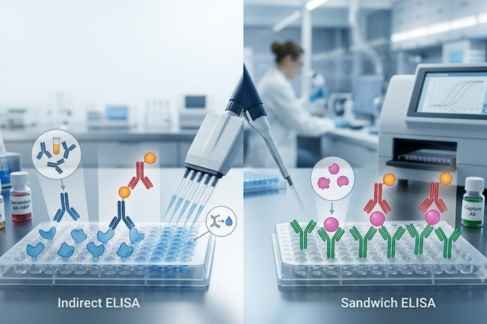
ELISA (Enzyme-Linked Immunosorbent Assay) is one of the most widely used laboratory techniques for detecting and measuring biological molecules. Researchers rely on ELISA immunoassay kits for antibody detection to study immune responses, identify disease biomarkers, evaluate vaccine efficacy, and support a variety of life science applications.
Among the different ELISA formats available, Indirect ELISA and Sandwich ELISA are two of the most commonly used methods. Although both are based on antigen-antibody interactions, they differ in their design, detection strategy, sensitivity, and ideal applications.
Understanding these differences can help researchers choose the most appropriate ELISA kit for their experimental objectives.
What Are ELISA Immunoassay Kits?
ELISA immunoassay kits are laboratory assay systems designed to detect or quantify specific biological molecules through highly specific antigen-antibody binding. Depending on the assay format, ELISA kits can measure:
- Antibodies
- Antigens
- Cytokines
- Hormones
- Growth factors
- Disease biomarkers
Most ELISA kits include pre-coated microplates, detection antibodies, enzyme conjugates, standards, buffers, substrates, and detailed protocols, making experiments more standardized and reproducible.
Understanding the Different ELISA Formats
Several ELISA formats are available, including:
- Direct ELISA
- Indirect ELISA
- Sandwich ELISA
- Competitive ELISA
Each format is designed for different research applications. Among them, Indirect ELISA and Sandwich ELISA are particularly popular because of their versatility and reliable performance.
What Is an Indirect ELISA?
Indirect ELISA is primarily used to detect antibodies present in biological samples such as serum or plasma.
In this format, the antigen is first immobilized on the microplate. If antibodies specific to that antigen are present in the sample, they bind to the coated antigen. A secondary enzyme-linked antibody is then added to detect the bound primary antibody, producing a measurable color change after substrate addition.
How Indirect ELISA Works
Step 1: Antigen Coating
A purified antigen is immobilized on the ELISA plate.
Step 2: Sample Incubation
The biological sample is added. If target antibodies are present, they bind to the antigen.
Step 3: Secondary Antibody Binding
An enzyme-conjugated secondary antibody binds specifically to the primary antibody.
Step 4: Signal Detection
A substrate reacts with the enzyme to generate a color change that can be measured using a microplate reader.
Advantages of Indirect ELISA
Indirect ELISA offers several benefits for antibody detection.
High Flexibility
The same enzyme-conjugated secondary antibody can often be used with multiple primary antibodies, reducing reagent costs.
Good Signal Amplification
Because several secondary antibodies may bind to one primary antibody, the assay often produces stronger signal intensity.
Cost-Effective
Indirect ELISA typically requires fewer specialized detection reagents than some alternative assay formats.
Suitable for Immune Response Studies
Researchers frequently use indirect ELISA to measure antibody production following infection or vaccination.
Limitations of Indirect ELISA
Despite its advantages, indirect ELISA has some limitations.
- Additional incubation steps increase assay time.
- Cross-reactivity of secondary antibodies may increase background signals.
- Results depend on the availability of high-quality secondary antibodies.
What Is a Sandwich ELISA?
Sandwich ELISA is primarily designed to detect and quantify antigens rather than antibodies.
In this format, a capture antibody is immobilized on the plate. The target antigen binds to this capture antibody, followed by a second detection antibody that recognizes a different epitope on the same antigen. This creates an antibody-antigen-antibody “sandwich.”
Because two antibodies recognize the target molecule, Sandwich ELISA offers excellent specificity and sensitivity.
How Sandwich ELISA Works
Step 1: Capture Antibody Coating
A capture antibody specific to the target antigen is coated onto the microplate.
Step 2: Sample Addition
The sample is introduced, allowing the target antigen to bind to the capture antibody.
Step 3: Detection Antibody Binding
A second antibody binds to another epitope on the antigen.
Step 4: Enzyme Reaction
An enzyme conjugate and substrate produce a measurable color signal proportional to the antigen concentration.
Advantages of Sandwich ELISA
Sandwich ELISA is one of the most sensitive ELISA formats available.
Excellent Specificity
Two antibodies recognizing different epitopes greatly reduce non-specific binding.
High Sensitivity
The dual-antibody design enables accurate detection of low-abundance proteins.
Minimal Sample Purification
Complex biological samples can often be analyzed without extensive purification.
Quantitative Analysis
Sandwich ELISA is widely used to quantify proteins, cytokines, hormones, and biomarkers.
Limitations of Sandwich ELISA
Researchers should also consider several challenges.
- Requires two compatible antibodies that recognize different epitopes.
- Assay development can be more complex.
- Kits are often more expensive than indirect ELISA formats.
Indirect ELISA vs. Sandwich ELISA: Key Differences
| Feature | Indirect ELISA | Sandwich ELISA |
| Primary target | Antibodies | Antigens |
| Plate coating | Antigen | Capture antibody |
| Detection method | Enzyme-linked secondary antibody | Detection antibody recognizing a second epitope |
| Sensitivity | High | Very high |
| Specificity | High | Excellent |
| Background signal | Moderate | Lower |
| Best applications | Antibody detection | Protein and biomarker quantification |
When Should You Choose Indirect ELISA?
Indirect ELISA is generally the preferred choice when the goal is antibody detection.
Serological Research
Researchers evaluate immune responses following infection or vaccination.
Autoimmune Disease Studies
Indirect ELISA helps identify autoantibodies associated with autoimmune disorders.
Vaccine Development
Scientists measure antibody production during vaccine evaluation.
Epidemiological Studies
Large population studies frequently use indirect ELISA to assess antibody prevalence.
When Should You Choose Sandwich ELISA?
Sandwich ELISA is ideal for detecting proteins present at low concentrations.
Cytokine Analysis
Researchers measure inflammatory cytokines in biological samples.
Biomarker Research
Sandwich ELISA supports the quantification of disease-associated biomarkers.
Hormone Detection
The assay is widely used to measure peptide hormones and growth factors.
Cell Signaling Research
Scientists investigate proteins involved in signaling pathways and immune regulation.
Factors to Consider When Selecting ELISA Immunoassay Kits for Antibody Detection
Choosing the right ELISA kit depends on your research objectives and sample type.
Target Molecule
Determine whether the experiment requires antibody detection or antigen quantification.
Sensitivity Requirements
Low-abundance analytes may require highly sensitive assay formats such as Sandwich ELISA.
Sample Type
Consider whether the samples are serum, plasma, cell culture supernatants, tissue lysates, or other biological materials.
Specificity
Assays requiring minimal background interference benefit from highly specific antibody pairs.
Validation and Reproducibility
Select ELISA kits that have been validated for the intended application and include comprehensive quality control documentation.
Best Practices for Reliable ELISA Results
Following standardized laboratory procedures helps improve assay performance.
Use Proper Controls
Include positive, negative, and blank controls to verify assay accuracy.
Follow Recommended Incubation Times
Consistent incubation conditions improve reproducibility.
Minimize Pipetting Errors
Accurate liquid handling reduces experimental variability.
Wash Thoroughly
Proper washing helps reduce background noise and improve signal quality.
Store Reagents Correctly
Maintain recommended storage conditions to preserve reagent stability and assay performance.
Conclusion
Both Indirect ELISA and Sandwich ELISA are valuable techniques, but each serves a different purpose. Indirect ELISA is the preferred choice for detecting antibodies and studying immune responses, while Sandwich ELISA provides superior sensitivity and specificity for quantifying antigens such as proteins, cytokines, and biomarkers.
Selecting the right ELISA immunoassay kits for antibody detection depends on your target molecule, experimental goals, sample type, and sensitivity requirements. Understanding these differences allows researchers to generate accurate, reproducible, and meaningful results across a wide range of life science applications.
If you’re wondering where to buy high-quality ELISA immunoassay kits designed to support reliable antibody detection and biomarker research across diverse scientific applications, you can rely on MyBioSource.
 Renuka