
If you search the internet to find out how long cybersecurity training is, you will find a lot of vague answers. Colleges will tell you it takes four years of reading textbooks. Bootcamps will claim they can turn you into a master hacker in 14 days. Both are misleading.
In the real world, training is measured by how long it takes you to master deployable, physical skills.
For most adults in a focused, fast-track program, the timeline takes roughly 7 to 10 months. But that time is not one long blur of coding. It is a strict gauntlet divided into three distinct checkpoints. In the IT industry, this path is unofficially known as the “CompTIA Trinity.” You cannot secure a network until you know how to build one.
Here is exactly what that timeline looks like, phase by phase.
Months 1 to 3: The Hardware Foundation (A+ Preparation)
You cannot defend a server if you do not know how a hard drive physically writes data.
The first phase of your training completely ignores hackers and firewalls. Instead, you strip the computer down to its bare metal. You learn how the motherboard distributes power, how the RAM temporarily holds running applications, and how to use the Windows Command Prompt to force a frozen machine to shut down.
During these first few months, a rigorous curriculum prepares you to challenge the CompTIA A+ certification exams. You spend your time memorizing motherboard form factors, troubleshooting blue screens of death, and understanding the physical differences between an SSD and a mechanical hard drive. You are building the foundation.
Months 4 to 6: The Digital Plumbing (Network+ Preparation)
Once you understand the single computer, you have to connect it to the rest of the world. This is where the timeline gets mathematically intense.
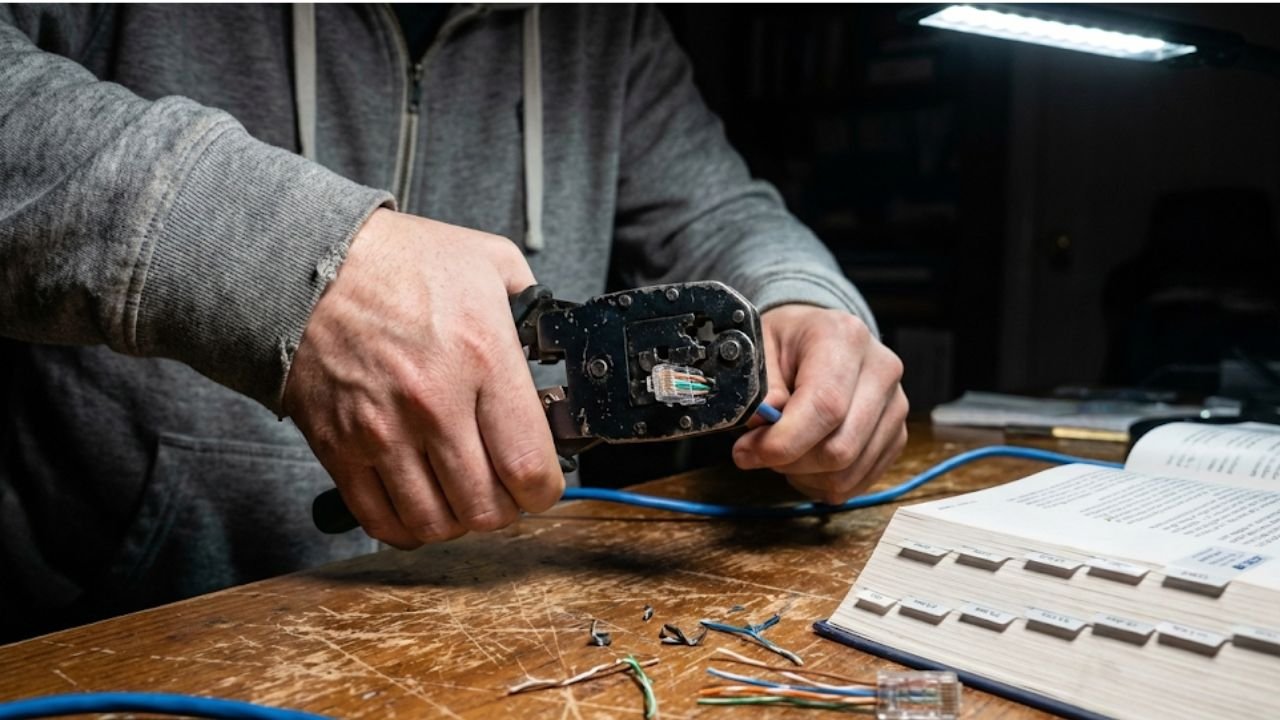
In the second phase, you learn the plumbing of the internet. You physically learn how to crimp the eight tiny copper wires inside a Cat6 ethernet cable. You learn how a router takes a massive corporate network and mathematically slices it into four secure, isolated digital rooms using binary subnetting. You memorize the exact port numbers for email, web traffic, and secure file transfers.
By the end of this phase, your training has equipped you with the knowledge to sit for the CompTIA Network+ exam. You now know exactly how data physically travels from a laptop in Texas to a server in Japan in under a second.
Months 7 to 10: The Defense Strategy (Security+ Preparation)
Only after you have mastered the hardware and the network do you finally get to the security phase.
Now that you know how the data flows, you learn how to put locks on the pipes. This final stretch of training prepares you for the CompTIA Security+ exam. You stop building networks and start breaking them in controlled virtual labs.
You execute physical tasks. You write firewall rules to block an IP address coming from Russia. You deploy a “Honeypot” server to trap an automated malware script. You learn how Cryptographic Hashing scrambles a user’s password into an unreadable string of 64 characters so that even if a hacker steals the database, they cannot read the passwords. You are finally doing the job.
Why You Cannot Skip to the End
Beginners always want to skip the first six months. They want to jump straight to the “ethical hacking” tools.
But if you skip the foundation, you will fail the technical interview. If an IT Director asks you to block a specific subnet from accessing the HR database, and you do not know how to calculate a subnet mask, all your security knowledge is completely useless.
That is why comprehensive cybersecurity training programs force you to walk the entire gauntlet. They do not just hand you a certificate; they force you through the grueling, necessary steps to prepare for the industry’s most respected exams.
The Verdict
How long does it take? It takes exactly as long as you need to master the machine, map the network, and lock the doors. If you dedicate a few focused hours a day to this three-step progression, you can transform from an absolute beginner to a hireable professional in under a year.
 David Martinez