
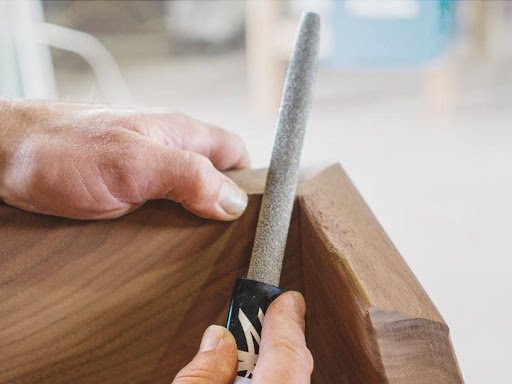
Woodworking relies on a wide variety of hand tools, and one that often doesn’t get the attention it deserves is the rasp. While many people jump directly from saws and chisels to sandpaper, rasps fill an important middle ground. They can shape, refine, and smooth wood in ways that other tools cannot. However, not all rasps are the same. The two most common types—fine rasps and coarse rasps—serve different purposes, and choosing the right one can greatly affect the efficiency and quality of your work.
What Is a Rasp?
A rasp is a type of file specifically designed for wood. Unlike metalworking files, which have uniform ridges, rasps are covered with sharp individual teeth that bite into the surface. This makes them particularly effective for quickly removing material while still allowing for controlled shaping. They come in different shapes—flat, half-round, round, and specialized forms like rifflers. Within these variations, rasps are classified by how fine or coarse the teeth are.
Understanding Coarse Rasps
A coarse rasp has larger, more widely spaced teeth. These are designed to remove wood aggressively and are best used in the early stages of shaping. For example, when roughing out a furniture leg, carving the curves of a chair arm, or taking down excess material on a joint, a coarse rasp can save significant time.
The downside of coarse rasps is that they leave a rough surface, often with visible scratch marks. For this reason, they are rarely the last step before finishing. Instead, coarse rasps are the tool of choice when speed and heavy stock removal matter more than surface quality.
The Role of Fine Rasps
A fine rasp, on the other hand, has smaller and more densely packed teeth. This design makes it less aggressive but far more precise. Fine rasps excel at refining shapes, smoothing contours, and preparing wood for later finishing stages.
They are especially useful when working on delicate curves, sculptural details, or instrument making, where every stroke must contribute to a clean, controlled surface. A fine rasp removes material gradually, reducing the risk of gouging or tearing fibers. In many cases, surfaces shaped with a fine rasp need only light sanding to be finish-ready.
Comparing Fine and Coarse Rasps
When deciding between a fine rasp and a coarse rasp, the main factors are project stage, material hardness, and desired finish quality.
- Speed vs Precision: Coarse rasps are faster, while fine rasps prioritize precision.
- Surface Quality: Coarse rasps leave rough marks, while fine rasps leave smoother, more consistent surfaces.
- Material Hardness: On softwoods like pine, a coarse rasp can sometimes tear fibers. A fine rasp offers more control and a cleaner cut. On hardwoods like oak or maple, a coarse rasp can be more efficient in the initial stages.
- Workflow: Many experienced woodworkers use both, starting with a coarse rasp to rough-shape the workpiece and switching to a fine rasp for refinement.
Hand Rasps and Their Importance
Hand rasps, particularly those that are hand-stitched rather than machine-made, offer unmatched performance. A hand-stitched rasp is crafted by individually striking each tooth into the steel surface. This process produces teeth that are slightly irregular in spacing and angle, which helps prevent clogging and ensures a smoother, more natural cut.
Machine-made rasps, by contrast, have perfectly uniform teeth that can sometimes chatter on the surface of the wood, leaving less desirable patterns. While hand-stitched rasps are more expensive, many professional woodworkers and luthiers consider them essential for achieving the highest quality finish. Both fine rasps and coarse rasps are available in hand-stitched versions, making it possible to build a complete shaping toolkit with superior cutting performance.
Choosing the Right Rasp for the Task
The decision between fine and coarse rasps depends on the woodworking task:
- Rough Shaping: For quickly reducing material, such as shaping furniture components or preparing carved pieces, a coarse rasp is the best choice.
- Detail Work: For refining curves, smoothing transitions, or preparing wood for finishing, a fine rasp is more appropriate.
- Mixed Workflow: In most projects, both are used together. Start with a coarse rasp to establish the form, then switch to a fine rasp for precision and smoothness.
- Tool Variety: Having multiple shapes—flat, half-round, and round—ensures you can match the rasp to the contours of your project.
Conclusion
Whether you are carving furniture legs, shaping sculptural details, or working on intricate projects like instrument making, understanding when to use a fine rasp and when to reach for a coarse rasp is crucial. Coarse rasps save time during rough shaping, while fine rasps provide the control and surface quality needed for finishing. Hand rasps, especially those that are hand-stitched, enhance this process by offering superior cutting action and durability. For woodworkers seeking even more versatility in shaping and detailing, combining these traditional tools with modern options like rotary carving tools for wood can create an efficient and precise workflow that elevates the final result.
 Renuka
  David Martinez