
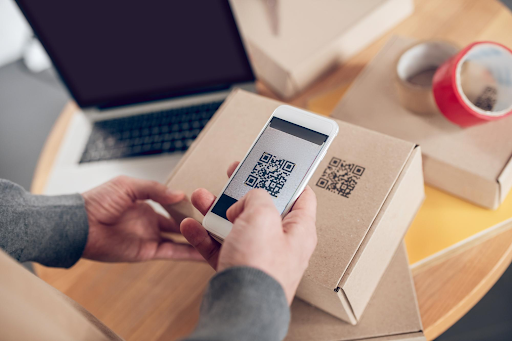
Do you know that not every barcode is authentic and genuine? Authentic barcodes encode GTIN (Global Trade Item Number). In this blog, we will learn in detail about GTIN, encoded in the barcodes of retail products. You will also know how to get barcode online through an authorised barcode seller.
What is a Barcode and Why Do You Need One?
A barcode is a data carrier which encodes product data. When scanned via a barcode scanner, this data is captured, enabling the sharing of accurate product details. These product details are encoded within a barcode. It plays a critical role in the global supply chain by facilitating efficient supply chain processes – from manufacturing to final product delivery. Having a barcode on products is not a personal requirement, but a business need. The global supply chain standards organisation – GS1, has set standards for structured product identification.
Currently, GS1 has 120 Member Organisations (MOs) affiliated with it across 150+ countries. GS1 India is one of them. GS1 India has been issued ‘890’ as its country code by GS1. Hence, all authorised and genuine barcodes in India begin with ‘890’ only. Such barcodes help businesses ensure their products –
- can be traded seamlessly across borders,
- face limited trade restrictions,
- are structured and standardised,
- are compliant with regulatory requirements, and more.
Traditional vs Online Barcode Generation
To get GS1 barcodes or barcodes beginning with ‘890’, business owners do not need to visit GS1 India’s office physically, for barcode registration. Businesses can easily apply for barcodes through GS1 India’s official website and get barcodes online.
Applying for barcodes online helps save the time, fuel, money, and energy of businesses. GS1 barcode registration is also very simple; applicants need to fill out their registration form and pay the applicable fees.
How to Easily Get a Barcode Online
Below is a step-by-step process of getting barcodes online –
- Visit GS1 India’s website or follow this link – https://www.gs1india.org/
- Navigate to the ‘Register for Barcodes’ page, under the Services tab.
- Click on the ‘Register Now’ button
- Fill out the registration form by providing your organisational details with supporting documents
- Select the number of barcodes you want to subscribe to*
- Pay the registration fee
- Within a few working days, you will receive your barcode allotment letter along with your GCP (GS1 Company Prefix).
- Use the GCP to log in to your DataKart account.
- Generate GTINs on DataKart and download the barcode image.
- Send the barcode image for bulk printing to start applying on products.
*Please note that once subscribed, barcodes can not be upgraded and can only be renewed. If you have subscribed for 10000 barcodes initially, you will not be able to upgrade it to 100000 barcodes or more. To do so, you will have to obtain a new barcode licence from GS1 India. Kindly consider your future requirements before making a purchase.
Types of Barcodes You Can Get Online
There are mainly two types of barcodes: 1D and 2D. 1D barcodes are traditional barcodes which have limited data storage capacity and require specific scanners or special smartphone applications to get scanned.
2D barcodes are more advanced and are also termed as the next-generation barcodes. 2D barcodes can store much more data in comparison to 1D barcodes. Due to this, their adoption is multiplying across industries – from retail to pharmaceuticals.
1D barcodes have different types –
EAN/UPC Barcodes
EAN/UPCs are used in retail markets. They are of two types each –
- EAN-13 – General barcode, encodes 13-digit GTIN, accepted and used globally for retail product identification.
- EAN-8 – Barcodes applied to smaller products with space constraints. It encodes an 8-digit GTIN.
- UPC-A – Encodes a 12-digit GTIN, used in North America, accepted globally.
- UPC-E – Encodes 8-digit GTIN, used in North America for unique identification of smaller products, similar to EAN-8.
GS1-128 Barcode –
The GS1-128 barcode is used for logistics and supply chain management. It encodes data with Application Identifiers (AIs), enabling detailed product information such as batch numbers, expiry dates, or serial numbers. Widely used in shipping and distribution, GS1-128 ensures accurate tracking, traceability, and efficient global trade compliance.
ITF-14 Barcode –
ITF-14 is a barcode standard primarily used on outer cartons and packaging. It encodes a GTIN-14 to identify product cases for distribution and inventory management. Its thick, durable bars make it suitable for printing on corrugated surfaces, ensuring readability in warehouses and shipping environments worldwide.
2D barcodes have two types –
QR Code
QR Code is a widely recognised 2D barcode that stores alphanumeric data and can encode digital information. It can carry product details, traceability data, or nutritional details. Its fast readability, smartphone compatibility, and ability to hold extensive data make it ideal for consumer engagement and supply chains.
GS1 DataMatrix Barcode
GS1 DataMatrix is a 2D barcode capable of encoding large amounts of information in a compact space. It supports Application Identifiers for data like the GTIN, batch number, and expiry date. Commonly used in healthcare and pharmaceuticals, GS1 DataMatrix ensures product authenticity, regulatory compliance, and efficient scanning, even on very small items.
Conclusion
All the different types of barcodes discussed in this blog can be downloaded through the DataKart service of GS1 India. Businesses that wish to start their selling journey can analyse and identify which barcode type would suit their requirements the most. Please refrain from getting barcodes from any other source apart from GS1 India, as such barcodes can face restrictions and may also get delisted from leading e-marketplaces like Amazon, Flipkart, Myntra, BlinkIt, and more.
 Renuka